Log building with historic significance gets a new lease on life… by Matt Edmunds

log sauna

Oldest Finnish sauna in the U.S.

We worked on an historic Finnish-style log structure back in 2004 located near Cokato, MN. The log “savu”or “smoke” sauna at Temperance Corners is a prime example of the Finnish- style of log construction. Known as the “Savu Sauna”, this is the oldest Finnish sauna in the United States at the ripe old age of 140.  This type of sauna had an open fire that was built right in the sauna building. After heating it up for hours, the fire was put out and then water was poured over the pile of rocks that was in the sauna creating a piping hot steam sauna. Since those days, some things have improved with time when it comes to taking a sauna.

Click here for more on the Cakato Finnish American Historical group.

log sauna

Notice the lack of a foundation.

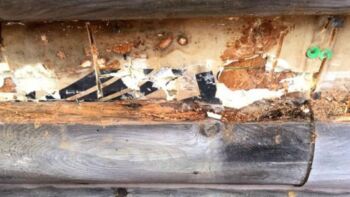
One thing we have found to be true with these turn-of-the-century log buildings is that in almost every case, they have marginal foundations. It is always important to consider this when assessing the structural integrity of an historic log building. Everything starts with a solid foundation, which keeps logs free of moisture from the ground. The Savu Sauna was a classic example of a building that had everything going for it except one thing – it needed a new foundation.  Read more…

Log Home Construction Finnish-style by Blaise Sopiwnik

Here in Wisconsin and Minnesota, Finnish settlers have set the bar high for hewn log construction.  Finns are the ones who created the log cabin that we all envision. In this post I will discuss Finnish log homes, as well as how and why they were constructed. I will also give some examples of projects done on these original-style log homes illustrating some aspects of maintenance and repair of these structures. First I want to give you a description of what a hewn Finnish-style log home is.

Finnish dovetail hewn log structures are some of the most solid log buildings ever constructed. These buildings were all built with hand tools such as cross cut saws, broad-axes, mallets and different types of chisels. These were structures of necessity. Settlers needed shelter, often quickly, and they possessed the knowledge and the tools to build it. Logs were plentiful.

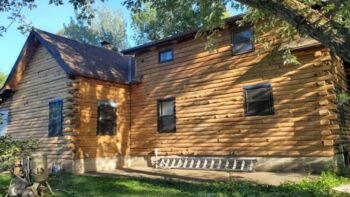
Finnish-style log home

The first consideration of any builder is its actual location and what species of mature trees could be harvested near by. The quality of mature trees was a main deciding factor in where to build. Trees were harvested on site in most cases. The desired species of trees included White Pine, Hemlock, Eastern White Cedar, and Oak.

After felling and limbing the trees, the builder would immediately set out to hew (flatten the log) and shape the logs to start drying out the timber. This included cross cutting the logs to a certain depth and then broad axing the extra material away from the log creating a top flat and a bottom flat with rounded edges on the sides. This process would expose heartwood, which is the hardest, most rot-resistant part of the tree. This also opened up the log to air dry the center, thus reducing the possibility for extreme shrinkage later in the building’s life.  Next it was time to lay out the corner dovetail joints.  Read more…

Log bridges for sale

Hot off the press… Edmunds and Company goes into the log bridge building business!

log bridge

Anna and Reed Edmunds at work on the bridge.

Due to the lack of snow this winter, the Edmunds family decided to complete a fun family project during the Christmas break. We built a log bridge on our property.

log bridge

Freshly groomed after 14'" of snow on March 2, 2012

We had so much fun we decided to market them. This one is 30 feet long and six feet wide. The bridge is made with sustainably harvested, rot-resistant Western cedar logs and struts, local Tamarack railings, and a pine deck.

In our business of restoring log homes, the materials to build these bridges is readily available to us. The beauty of the design and construction is that we can build one almost anywhere.

log bridge

Picture this bridge on your property. Would sell for $4,000, installed within 100 miles of Washburn WI.

Look for more in the coming months about options and pricing. If you, or someone you know, wants a walking, Nordic, or an ATV bridge, contact us at 877-378-4403 or email us at info@restorelogs.com.

If you would like to learn more about our company and the work we do, see us on www.restorelogs.com.

Interested in a log bridge? Call us at 877-378-4403 or email us at info@restorelogs.com.


Log homes back then and now

A building that embodies rural living is a place with beauty, clear air, and space to roam…yes, I am talking about the log home. These structures stir our imagination, sending us back in time when family and connection to the land meant something. It is those structures that have survived that now hearken us back to the time when pioneers founded this area. Through this blog I would like to open up a dialogue about different log homes and cabins and what they mean to us. All of these structures have an interesting history that when looked at closely, can reveal a wealth of knowledge on how to maintain and preserve the more modern log buildings of today.

I grew up in northern Wisconsin and from a young age traveled around the upper Midwest restoring log homes and cabins with Edmunds and Company.  I have always been inspired by the mystique of early American settlers. What they must have endured to pioneer this country is nothing short of astounding. Books like “A Reverence for Wood” and “Diary of an Early American Boy” by Sloan have helped create the ethos of my childhood.  A person could say it is akin to a certain lifestyle connection, bringing me closer to my ancestors who settled here in America.

Scandinavian styled corners

Typical corner construction on Scandinavian-built log homes.

In my 15-year career at Edmunds and Company I have had a chance to spend many hours restoring the early American buildings that number in the hundreds of years old. In this restoration work, I have found there is a delicate balance between form and function, regardless of the style of log building. Every building has a unique story behind it- whether it is a particular builder, type of wood native to a certain region of the country, or the architectural lineage.  Through this blog I will explore past and current projects while blending natural history, cultural history, and personal history. I will try to tie current everyday design elements into the discussion, keeping in mind that Scandinavian log homes have been around since somewhere between 10,000 and 8,000 BC.  With Matt’s input, we intend to create a working chronology of the designs of log homes here in the Midwest – what are these types, when and who built them, and why?  From there we intend to grow the discussion to what they mean to us today and how to we take care of them so that in 100 years, we can discuss the buildings of today as “historic”.

The first and oldest form of log home is the Scandinavian hewn-style log building and this is where I will start.  Here in the north woods of Wisconsin, Scandinavian settlers brought with them skills to build solid log homes of many shapes and sizes.  Designs that we often see today include “D” log, turned log or manufactured log, stockade or vertical log, round scribed, chinked style and many sub categories of all of these. Over the next six months, I look forward to exploring the elements and the long, rich history of these log homes.  Following each weekly post, I encourage any feedback from you, the reader, on what you find intriguing. This might include a cabin you already own.

Look for the “Scandinavian Log Homes” post next week.

Any idea what this is? Email us your answer.

Anyone know what this is? Email the answer to us at info@restorelogs.com.

Coming Soon: Edmunds & Company “Log Home Trivia and Picture Contest”. We will draw names and give away five Edmunds and Company Log Home Restorations hats for emailing us the correct answer.

Introducing Spring 2012 Log Blog Article Series

Written by Matt Edmunds and Blaise Sopiwnik

I have spent many days, from childhood until now, in the dark, less-than- pristine underbellies of the old log buildings we restore. During these hours, I have often wondered what might have caused the builders of long ago to construct this particular log building. Who were the builders? Why this style? Why this place?

Whole log home

An example of a whole log home with scribed corners

In restoring and repairing log homes, I am interested in understanding what might have influenced people to build a certain structure, with a particular technique, in that particular spot. Sometimes this holds the key to figuring out how we will fix a given problem within a building. Sometimes we just find interest in pondering the building and the family folklore it holds.

In an upcoming series of blog postings, we will explore the different types of log homes and the histories they each hold here in the Midwest. We hope that the reader will come away not only with an understanding of the nuts and bolts of how these log homes were constructed, but begin to wonder why they were built. I have always wanted to describe the different types of log homes as a way to help log homeowners better understand and maintain their cabins and homes.

So here we go. Over the next two or three months, we will post a series of blog articles exploring different types of log home construction. We hope you find this informative and interesting.

Edmunds & Company Welcomes Blaise Back

blaise is back!

Welcome back Blaise!

Edmunds and Company is excited to welcome back our old friend, Blaise Sopiwnik. Blaise started working with Edmunds and Company long ago as a teenager, alongside his father, Jesse.

Jesse is now a foreman and one of the company’s longest standing crew members. For the last three years, Blaise has been an admissions counselor at Northland College in Ashland, WI, where he oversaw a three-year increase in enrollment.

blaise and John sopiwnik

Blaise with his brother, John. A fish caught off-hours on a restoration job in Wisconsin.

Blaise brings to the table his project management and marketing skills as well as a fresh outlook. This spring, Blaise and I will be working together to write a series of articles about our experience restoring and repairing log homes, so stay tuned. Welcome back, Blaise!


Oily Soap (Or How to Win Friends and Influence Bosses)

The “road” is more than a straight line between departure and destination.  It is a place in itself, especially to those who practice their craft for Edmunds and Company Log Home Restorations.  Each place on the road has its unique characteristic, whether it is the house we are working on, or its location.  Life can be difficult on the road, but it also holds an attraction for us.  It is a world of its own.  Hence our tongue-in-cheek-dictum, “What happens on the Road, stays on the Road.”  Our crew really doesn’t have any lurid events to hide from those at home, but if it did, who would understand?  I believe the statute of limitations has run out on the story I am about to tell.

Back in 1993, the Jurassic Period of Edmunds and Company, Matt Edmunds’ father Peter, then owner of the company, announced a major project east of Burlington, Vermont near Underhill.  We would be restoring a family owned log home situated at the end of a dirt road and the trail head leading to Mt. Mansfield in the state park of that name.  It would be a working vacation and we were invited to bring the family.  Food and transportation were provided.  We log workers were thrilled to take the family on a long journey to the beautiful mountains of Vermont and get paid for it to boot.

We camped on the sight (most of us are experienced campers and canoeists) of the historic cabin built just after the Civil War.  It was almost beyond redemption but still worth saving.  We demolished the crumbling stone chimney and rotten floors, letting them fall into the dank cellar of the building.  We jacked up and supported walls, rebuilt the floor, then proceeded to replace rotten logs, imitating the joinery in vogue here during Abe Lincoln’s presidency.

Current and former crew members. Jesse and Peter are on the far right of the photo.

The camping went well despite a spell of rain that made the mud at Woodstock look like a day at the beach. The children explored the trails which followed crystal clear streams into the highlands.  Some families took side journeys to concert events, visits to nearby relatives or other attractions in the area.  Our sojourns to exotic pizza joints, or restaurants in Burlington on the weekends were enjoyed by all.  Mostly though, we cooked and ate wonderful meals right in camp.  Read more…

Log home refinishing

Well, the log home refinishing and stain season has definitely come to an end. If you got your project done this summer, you can rest assured that your log home is protected. If your project got put off to next year, that’s OK too.

blasting

Don't do the blasting if you can't get the stain on it soon after.

It’s never too early to start thinking about the process of protecting your logs from the elements. There are always several steps in this process. Preparation is by far the most important and difficult to get right. Getting the surface of your logs ready to accept a stain may involve blasting off old, deteriorated finish, cleaning the logs with oxygen bleach or simply washing them with a garden hose. It all depends on the condition of your logs.

When the logs are “raw” after blasting, we recommend applying a  borate treatment to protect the logs against future rot. The final step in log home refinishing is applying a quality log home stain to the logs to protect them from the elements, including UV protection. Read on to learn more about different choices in stains, their advantages and disadvantages.

darkened stain

Darkened stain - before blasting

Log home stains are continually evolving and improving. Some stains that “in there day” were considered to be top-of-line have not stood the test of time. Certainly the improvements made are steps in the right direction. That said, I wish I could say that there is a “bullet-proof stain” as far as log home stains go but in our experience – there isn’t.

So what we look for are the good stains vs. the ones to stay away from. Our 30+ years of experience in the log home restoration business have resulted in a body of knowledge about refinishing and in particular – what type of stain to recommend to our customers.  Read more…

Log home repair – What can you put off until next year?

Now that the warm weather is behind us, we are busy finishing up the jobs we have lined up for the rest of our season. Once the snow flies, we take a break from log work and refinishing until next spring.

We are getting calls from people who are looking critically at their log homes and realizing that they are in need of some log home repair services.  They also realize that it is getting late in the season and they are wondering if it is detrimental for their logs if they wait until next year to have the repairs done.

blasting

Don't do the blasting if you can't get the stain on it soon after.

Here is some general advice: If you are thinking that the finish on your log home needs to be removed, but you are not sure you will be able to get it re-stained before the cold weather sets in, it is better to wait until spring to have the finish blasted off so that the new stain can be applied shortly following the blasting process. Letting logs go through a winter with no stain or protection on them is not advised.

What about logs that you know are rotten? Will they continue to rot over the winter and be even more deteriorated come spring? This is where cold weather is a benefit to logs with rot. The microorganisms that cause rot need to have temperatures in the 60-90 degree range. Once the temp drops below that range, the rotting process is halted temporarily until it warms up. Having said that, it is important to make sure that in the spring, the snow piles are not left to melt up against the logs. Moisture up against the logs is a problem waiting to happen.

cracks

A good example of checks that should be filled before winter.

The one thing that is advisable to do yet this fall is to check for cracks that are wider that ¼” and are on the up-facing side of the logs or in vulnerable places. Filling these checks with a quality caulk will keep the moisture from snow and rain from migrating into the logs and causing problems with rot. Click here for more information about filling checks and cracks in logs.

We are still doing estimates for people who are interested in having log home repair services done yet this year and we are also lining up projects for next spring. Give us a call at 877-378-4403 if you are interested in getting an estimate OR contact us via email.

RELATED LINKS AND TIPS ON LOG HOME REPAIR

Top ten ways to protect your logs and your investment
Frequently asked questions
Common Problems

Log home dry rot and what can be done to resolve it

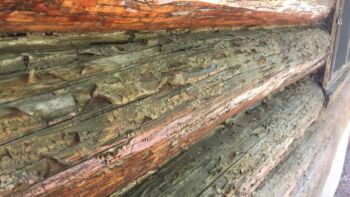
dry rotWe frequently get calls from log home owners saying, “My home has some dry rot.” When you look at the logs affected with rot, they DO look dry.

Whether the rot is dry or wet, rot equals decay and that is a serious problem in log buildings. Rot can lead to the need for replacing part or the entire log. There are several factors that can contribute to a log getting rot, but they all have to do with moisture getting into the wood. When wood fibers have a constant moisture level between 14-20%, wood will start to rot.

For more information on how we replace rotten logs, click here.

RELATED LINKS AND TIPS ON PREVENTING LOG HOME DRY ROT

Why do logs rot?
What to look for when buying a log home
Proper way to flash a deck to a log wall